This Lesson comprises of Model Exam papers and Answers
Chapter 01: Vectore Math - Mechanics
Tutorial 01 Rev Notes Revision 21.1 Definition of Vectors
A vector quantity has both magnitude and direction. Acceleration, velocity, force and displacement are all examples of vector quantities. A scalar quantity is has only magnitude (so the direction is not important). Examples include speed, time and distance. 1.2 Components of Vectors
The process of a splitting a vector is called resolution of a vector. In simpler language it would mean, determining the effect of a vector in a particular direction. The parts of the vector obtained after splitting the vector are known as Components of the Vector.
Rectangular components of a vector: If the components of a given vector are perpendicular to each other, they are called as Rectangular components. The figure illustrates a vector A represented by OP Through the point, O two mutually perpendicular axis X and Y are drawn. From the point P, two perpendicular, PN and PM are dropped on X and Y axis respectively.
The vector Ax is the resolved part of A along the X – axis. It also known as the X-component of A and is the projection of the vector A on X- axis. Similarly, Ay is the resolved part of the A along the Y – axis, and is therefore, known as the Y – component of A .
Applying the law of triangle of vectors to ONP, OP = ON + NP or A = Ax + Ay which also confirm that Ax, Ay are the components of A.
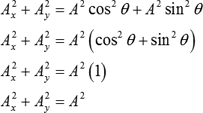
This equation gives the magnitude of the given vector in terms of the magnitudes of the components of the given vector.
In the figure, the velocity vector V is represented by the vector OP. Resolving V into its two rectangular components, we have V = Vxi + Vxj. In terms of the unit vectors i, j, V = Vxi + Vxj
Where,
Vx = V cosθ, Vy = V sinθ and tanθ = Vy/ Vx
How to find the Resolution of Vectors?
Example 01: The Diagram above shows two forces of magnitude 25N are acting on an object of mass 2kg. Find the acceleration of object, in m/s².
Solution: Given,
Mass (m) = 2kg
Horizontal component of the forces = 25 cos 45° + 25 cos 45° = 35.36 N
Vertical component of the forces = 25 cos 45° – 25 cos 45° = 0 N
The acceleration of the object can be determined by the equation Force (F) = mass (m) x acceleration (a)
(35.36) = 2 x a
Acceleration (a) = 35.36/3 = 17.68 m/sec²
Remarks:
The words magnitude and modulus mean the same thing with vectors
In geometry magnitude and modulus mean the distance of the vector
This is always a positive value
The direction of the vector is irrelevant
Magnitude or modulus is indicated by vertical lines
|a| would mean the magnitude of vector a
Example: When the force of 50N inclined at 40 degress to the horizontal is resolved into its rectangular components the resulrs are as shown below:
Resolve the vector below into its rectangular components
ASSUMPTIONS
• Objects are modelled as masses concentrated at a single point so no rotational forces.
• Strings are inextensible (inelastic) so any stretch can be disregarded
• Strings and rods are light (no mass) so weight can be disregarded
• Pulleys are smooth so no frictional force at the pully needs to be considered..